

Scribal Profile Unknown | |
| Current Manuscript: | Oxford, Bodleian Library MS e. Musaeo 16 |
| Folios: | 1-310 |
| Sampled Folios: | 8v |
| Example Page: | Display a full page showing this scribe's hand |
| Image Rights: | Reproduced with permission of The Bodleian Library, University of Oxford, 2011; all rights reserved. All images on this website are reproduced with permission of the Libraries, Archives, and Owners of the manuscripts. Manuscript images that appear on this website remain in the copyright of the libraries where the manuscripts are held. Use of these images for any purpose other than private study without written permission of those libraries is prohibited by law. |
| A | |||
 | Usage: at 'a' is always double compartment with straight sides and angled hairline at the left side of the head. | 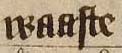 | Usage: waaste |
 | Usage: And upper case 'A' with 2-shaped element to begin. |  | Usage: And occasionally there is a shadow stroke to the right of the main down-stroke. It is not seen in this example, perhaps because as the initial letter of a line it would be slashed with red. |
| D | |||
 | Usage: dyuersite this is the most usual form of 'd' although as will be seen in the following examples, the scribe uses his imagination at times. |  | Usage: heede looped head on 'd'. |
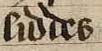 | Usage: liddes long wavy strokes rather than the usual short angled one for the final down-stroke. |  | Usage: De an elaborate upper case 'D' in the gloss. |
| G | |||
 | Usage: be'greued 'g' is tailed with a tail turning clockwise and extending in a long horizontal line which extends beneath previous graphs. |  | Usage: bleding final 'g' with extra tag extending above the graph and ending with a diamond shape. This may be the scribe's method of indicating a missing final 'e'. However, the same tag is also used as the 'dot' for 'y'. |
 | Usage: grustels |  | Usage: dyuers gobettes |
| H | |||
 | Usage: hele 'h' is usually neatly contained with straight limb ending with a small flick to the left. |  | Usage: Englissche after 'c' , 'h' is normally crossed. |
 | Usage: nought |  | Usage: cheekes the scribe frequently adds fine otiose loops or lines to several graphs as decoration. |
| R | |||
 | Usage: rounde the 'r' and the 'o' blend together in this example. |  | Usage: oþir final 'r' with fine otiose stroke merely for decoration. |
 | Usage: for 'z'-shaped 'r' almost always has an otiose loop beneath the graph. |  | Usage: cheere |
| S | |||
 | Usage: serue long 's' is used in initial and medial positions. It frequently has a number of 'fins' on the left side. The number varies and this example is rather overcrowded with them. |  | Usage: lymes kidney-shaped 's' in final position. |
 | Usage: mooste could be mistaken for an 'f' since the cross-bar of 't' bisects the stem of 's'. |  | Usage: suffiseþ a wing to begin the first long 's' and another heavily finned example. |
| W | |||
 | Usage: we 'w' is consistently formed throughout. |  | Usage: colowre 'w' is the same size as the graphs on either side. |
 | Usage: twey |  | Usage: iknowe |
| Y | |||
 | Usage: ynne 'y' is almost always dotted. The body is square-shaped and the tail is usually short and straight with no return. |  | Usage: þey |
 | Usage: Þey probably the only example on this folio where the tail of 'y' turns counter-clockwise. |  | Usage: yȝen |
| Thorn and Yogh | |||
 | Usage: neþir thorn is used frequently. |  | Usage: comeþ the stem of thorn is thick and straight with no taper. The lobe is a box-like addition. |
 | Usage: ȝif yogh is used as equivalent of both the 'y' and 'gh' elements. |  | Usage: hyȝe |
| Upper Case Letters | |||
 | Usage: But |  | Usage: Constantine |
 | Usage: Neþeles a rather tortured upper case 'N'. |  | Usage: Þe upper case Thorn with more fin decoration of the stem. |